STREET EXPERIMENTS AFRICA

This is a Young Urbanists Project

STREET EXPERIMENTS AFRICA

New ways to make streets safer

South Africa

Tactical Urbanism
Inspired by the Global Designing Cities Initiative, Street Experiments South Africa uses a test, measure and adapt approach to changing streets, applying temporary interventions before cities commit to permanent construction. The model combines implementation, community involvement and evaluation to help successful ideas move into everyday policy and practice.

Street Experiments South Africa is a Young Urbanists programme that adapts this approach to the South African context through temporary and semi-permanent street changes that work within existing municipal processes and road standards. The programme was pioneered through the Safer Streets Programme with Uber and the Urban Design and Mobility Forum, in collaboration with the City of Cape Town, the Mayor’s Office and Urban Mobility.

The programme focuses on two forms of experimentation. Open street experiments temporarily remove private vehicles to create space for walking, cycling, play and public life, while semi-permanent experiments use bollards, delineator kerbs, seating, landscaping and changes to road space to test new street designs over longer periods.

Bree Street Sundays became the first major open street test, closing Bree Street and parts of Shortmarket Street to private vehicles every Sunday during the warmer months. Building on the legacy of Open Streets Cape Town, it has shown how recurring car-free streets can operate as part of everyday city life rather than as conventional events, while reducing the cost and complexity of regular closures and supporting local businesses and public life.

The model has since expanded to Lerotholi Avenue Sundays in Langa and is being developed in Johannesburg through Main Street Sundays with Jozi My Jozi, with the longer-term aim of creating an Open Streets model that municipalities and communities can use regularly without treating each closure as a once-off event.

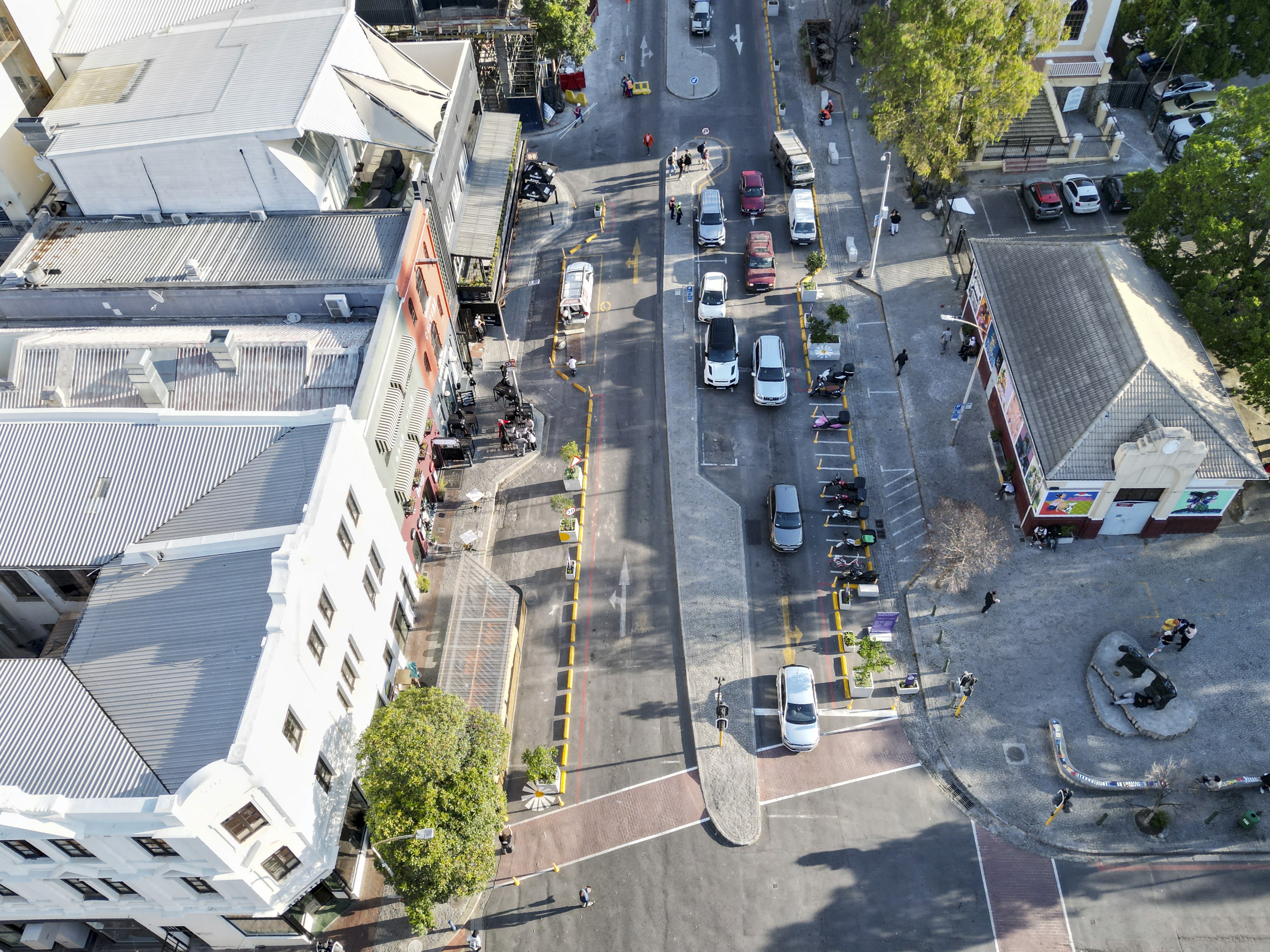
The semi-permanent side is being tested through the Bree Street Experiment, developed through the Urban Design and Mobility Forum and implemented as part of the Safe Passage Precinct. Between Wale and Shortmarket Streets, the pilot reallocates road space to one mixed-traffic lane in each direction, supported by delineator kerbs and bollards, expanded pedestrian areas, formalised loading zones, removable seating and landscaping.

The experiment tests Bree Street as a Special Activity Street in line with Cape Town’s CBD Mobility and Accessibility Plan, while maintaining access for vehicles, cyclists, public transport and deliveries. It also links with the Safe Mobility Hub Programme through street-level infrastructure that supports public life and last-mile mobility.

The next phase will expand this work into Langa, where the Active Mobility Forum, Young Urbanists, local residents, designers and the City of Cape Town are developing interventions for Bhunga Avenue, Lerotholi Avenue and Jungle Walk. The work will test safer crossings, slower traffic and better walking environments, supported by community engagement and data collection to guide future permanent changes.

In Johannesburg, Young Urbanists will work with the Johannesburg Inner City Partnership on a street experiment along Joubert Street between Park Station and Gandhi Square, focusing on safer intersections and stronger pedestrian connections. The route forms part of the JICP’s Inner City Walkable Network and creates an opportunity to put Johannesburg’s existing Complete Streets Design Guideline into practice through collaboration between government and civil society.

Street Experiments South Africa aims to give municipalities a practical route from temporary testing and evaluation to permanent infrastructure where the evidence supports it. The programme will continue developing models for recurring Open Streets and semi-permanent street redesign, while working towards their inclusion in municipal processes and the National NMT Guidelines as recognised implementation tools across South Africa.

Inspired by the Global Designing Cities Initiative, Street Experiments South Africa uses a test, measure and adapt approach to changing streets, applying temporary interventions before cities commit to permanent construction. The model combines implementation, community involvement and evaluation to help successful ideas move into everyday policy and practice.

Street Experiments South Africa is a Young Urbanists programme that adapts this approach to the South African context through temporary and semi-permanent street changes that work within existing municipal processes and road standards. The programme was pioneered through the Safer Streets Programme with Uber and the Urban Design and Mobility Forum, in collaboration with the City of Cape Town, the Mayor’s Office and Urban Mobility.

The programme focuses on two forms of experimentation. Open street experiments temporarily remove private vehicles to create space for walking, cycling, play and public life, while semi-permanent experiments use bollards, delineator kerbs, seating, landscaping and changes to road space to test new street designs over longer periods.

Bree Street Sundays became the first major open street test, closing Bree Street and parts of Shortmarket Street to private vehicles every Sunday during the warmer months. Building on the legacy of Open Streets Cape Town, it has shown how recurring car-free streets can operate as part of everyday city life rather than as conventional events, while reducing the cost and complexity of regular closures and supporting local businesses and public life.

The model has since expanded to Lerotholi Avenue Sundays in Langa and is being developed in Johannesburg through Main Street Sundays with Jozi My Jozi, with the longer-term aim of creating an Open Streets model that municipalities and communities can use regularly without treating each closure as a once-off event.

The semi-permanent side is being tested through the Bree Street Experiment, developed through the Urban Design and Mobility Forum and implemented as part of the Safe Passage Precinct. Between Wale and Shortmarket Streets, the pilot reallocates road space to one mixed-traffic lane in each direction, supported by delineator kerbs and bollards, expanded pedestrian areas, formalised loading zones, removable seating and landscaping.

The experiment tests Bree Street as a Special Activity Street in line with Cape Town’s CBD Mobility and Accessibility Plan, while maintaining access for vehicles, cyclists, public transport and deliveries. It also links with the Safe Mobility Hub Programme through street-level infrastructure that supports public life and last-mile mobility.

The next phase will expand this work into Langa, where the Active Mobility Forum, Young Urbanists, local residents, designers and the City of Cape Town are developing interventions for Bhunga Avenue, Lerotholi Avenue and Jungle Walk. The work will test safer crossings, slower traffic and better walking environments, supported by community engagement and data collection to guide future permanent changes.

In Johannesburg, Young Urbanists will work with the Johannesburg Inner City Partnership on a street experiment along Joubert Street between Park Station and Gandhi Square, focusing on safer intersections and stronger pedestrian connections. The route forms part of the JICP’s Inner City Walkable Network and creates an opportunity to put Johannesburg’s existing Complete Streets Design Guideline into practice through collaboration between government and civil society.

Street Experiments South Africa aims to give municipalities a practical route from temporary testing and evaluation to permanent infrastructure where the evidence supports it. The programme will continue developing models for recurring Open Streets and semi-permanent street redesign, while working towards their inclusion in municipal processes and the National NMT Guidelines as recognised implementation tools across South Africa.

Street Experiments Africa is a practical tool being developed with civil society, the private sector and government to test safer street designs before permanent infrastructure is built. Pioneered through recurring Open Streets and semi-permanent interventions on Bree Street in Cape Town, the programme is now expanding into Langa and Johannesburg, with the aim of giving municipalities a faster, lower-cost and evidence-led way to test, measure and implement street changes across South Africa.

Read more about Street Experiments Tools. Read more about Global Design Cities Initiative.

MEDIA

COLLABORATIONS SDI Trust, Safe Passage Programme, Young Urbanists NPC, Street Experiments Tools, Mission for Inner City Cape Town, City of Cape Town, Mayor’s Office, Urban Mobility Directorate, Spatial Planning and Environment Directorate, Cape Town Central City Improvement District, Active Mobility Forum, Langa Bicycle Hub, Green Riders, The Maak, University of Cape Town, Urban-Think Tank, Flat Rock Studio, StoneCast, Cape Concrete, Yes& Studio, MAROL, Centremark, Open Streets Cape Town, Open Streets Africa, Jozi My Jozi, Johannesburg Inner City Partnership, City of Johannesburg, Uber, Global Designing Cities Initiative and Dutch Creative Fund.

SPECIAL THANKS TO Brad Fisher at SDI Trust and RIM, Transportation Planning and Network Management at the City of Cape Town

NEXT STEPS Develop a practical toolkit for both Open Streets and semi-permanent street experiments, using the lessons and impact from Bree Street to guide future implementation. Expand the programme into Langa and Johannesburg, testing the model in different contexts while building the evidence needed for wider adoption by municipalities across South Africa.

We Advocate for Infrastructure, not paint. Fueled by Young Urbanists and the Bicycle Mayor of Cape Town

Sign up

Join the Active Mobility Forum today for a

car-free South Africa

© Active Mobility Forum Cape Town, Johannesburg, Durban & Pretoria | +27 76 451 8656

Stay in touch

Get emails about new projects by the Active Mobility Forum

© Active Mobility Forum Cape Town, Johannesburg, Durban & Pretoria | +27 76 451 8656